Mechanics, forces and energy
Mechanics examines motion and interactions. Educational sessions may use models, demonstrations and supervised measurements to explore forces, balance, speed or changing motion. Energy topics can connect everyday systems with ideas such as transfer, storage and efficiency. Ask whether students calculate, observe, model or combine those approaches.
Good measurement work includes units, repeat observations where appropriate and discussion of uncertainty. The aim is not to promise perfect results. It is to help students understand why instruments, methods and conditions affect what they can conclude.
From electricity to materials
Physics and engineering programs may include electricity, electronics or material properties. The listing should explain the educational level, equipment supplied and instructor oversight. Families should not infer that a topic title means unrestricted practical work. Activities need to follow qualified supervision, institutional procedures and age-appropriate safety controls.
Materials sessions may compare properties through safe, guided demonstrations or design tasks. Ask which materials are used and whether students handle them directly. For any equipment-based activity, look for clear staff responsibility and an explanation of the safety arrangements.
Three learning approaches
Experiment-based learning starts with a question and uses observation or measurement to examine it. Students may compare a prediction with evidence. This suits learners who like testing ideas, but the range of questions may be limited by time and available equipment.
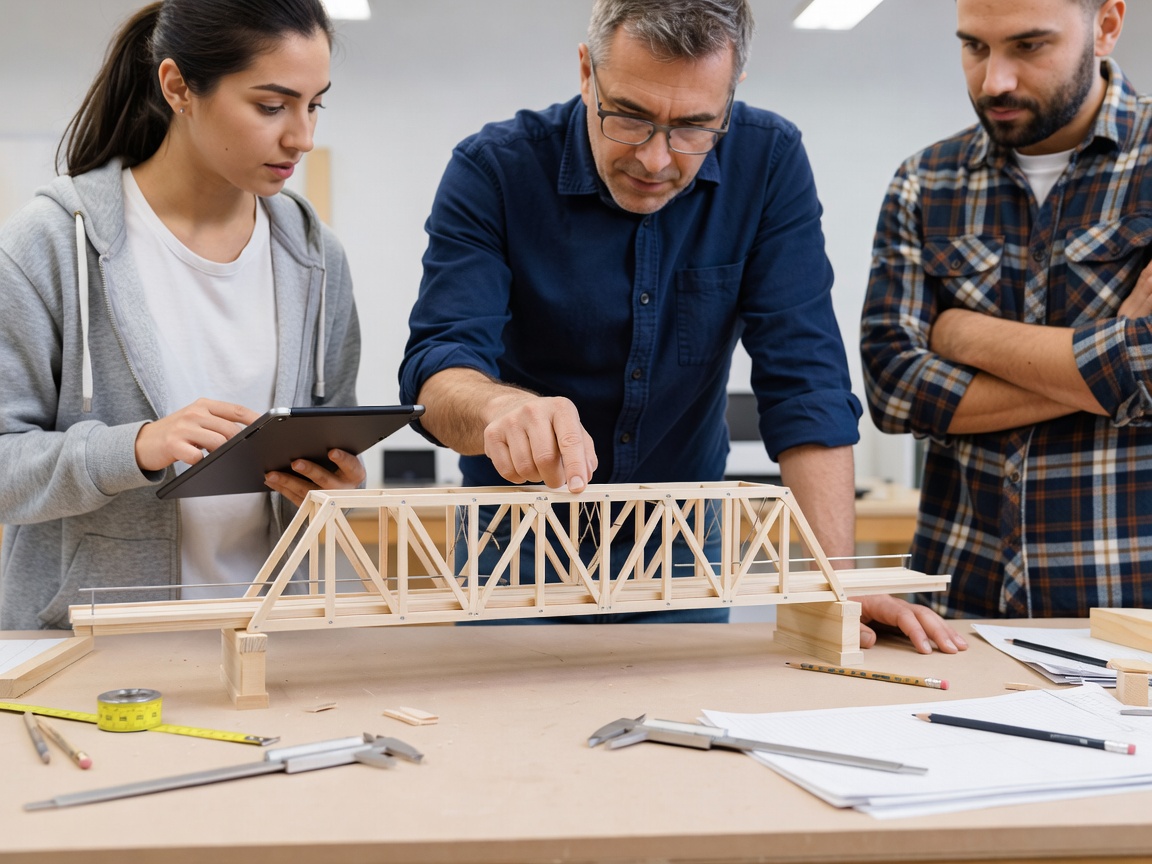
Engineering challenges set a design goal with constraints. Teams sketch, make a model, review its performance and consider changes. This supports iterative thinking and teamwork. Check that students have meaningful roles and that the challenge is more than a timed competition.
Theoretical instruction develops concepts through explanations, diagrams, calculations or simulations. It can provide a strong foundation, especially where equipment access is limited. A student seeking extensive building should check how much practical project time is actually scheduled.
Structures and prototyping
Structure activities can examine stability, load concepts and design trade-offs using supervised educational models. Prototyping may involve sketching, comparing materials or refining a low-risk model. Look for defined limits, staff review and age-appropriate tools. Avoid programs that leave the nature of construction, equipment or oversight unclear.
A useful project explanation states the task, available materials, supervision and how student decisions are reviewed. It should not promise that every design will work or that one activity proves a universal engineering rule.
Good for
This field can suit students who enjoy building, testing, measuring or asking how systems behave. A student who prefers explanation and calculations may value a more theory-led format. Those who like open-ended teamwork may prefer a design challenge, provided the group structure is clear.
What to check
- Balance of mechanics, energy, electricity and engineering design.
- Amount of explanation, guided experiment and project time.
- Equipment provision, age suitability and qualified supervision.
- How teams share tasks and how individual learning is supported.
- Safety procedures, accessibility and any stated prerequisites.
Choose by evidence of fit
Ask for a session outline and examples of student outputs, such as a recorded measurement, annotated model or design explanation. Clarify whether these are individual or group tasks. Compare learning format with the student's preferred pace and experience. No prior engineering background should be assumed unless requirements are clearly stated.
For families and schools, logistics matter too. Confirm schedule, clothing, transport and any equipment students are expected to bring. The organiser should explain safety arrangements directly. This guide is an educational comparison tool, not a substitute for provider-specific information.